
Best for:
Booklet printing · Saddle stitch binding · Multi-page products · Automatic page & sheet calculation
Saddle stitch booklets are multi-page printed products consisting of a cover and inner content, folded and stapled at the center.
When you want PriceCal to automatically calculate page count, sheet usage, imposition, and binding logic, SC-Booklet is the recommended product type.
When to Use SC-Booklet
Use SC-Booklet if you:
- Print booklets and Binding in-house
- Need to manage cover and content separately
- Want automatic page-to-sheet calculation
- Support different paper types for cover and content
A. First for all, you need to add a new product
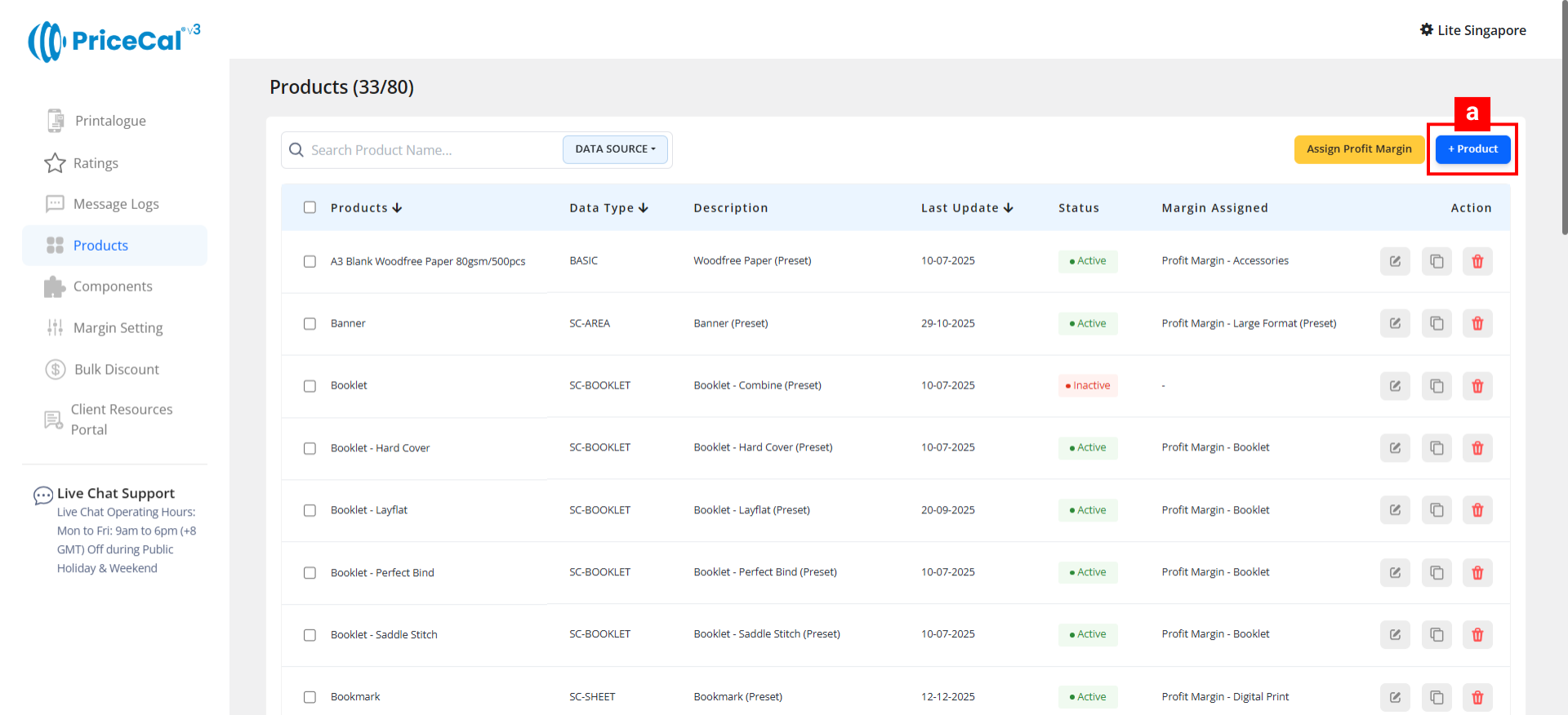
1. Select Product Source: SC-Booklet
2. Enter the product code: You can enter your product SKU or product abbreviation. Example, Demo-Saddle Stitch Booklet >> DM-SSB
3. Product Name: Booklet – Saddle Stitch
4. Description: In-house production / Booklet Saddle Stitch (only admin can view this in the PriceCal dashboard)
5. (Optional) Set rounding to set the price to an integer based on your market price
6. (Optional) Min Order Amount: for min charge for this job no matter the size or quantity.
Example: If you select a print price of $9, but the minimum order amount is $15, then this order will be charged $15 unless the print price is higher than $15.7. Enter the slug name: saddle-stitch-booklet
Slug must be lowercase, contain only letters, numbers, and ‘-‘, and cannot start or end with a ‘-‘
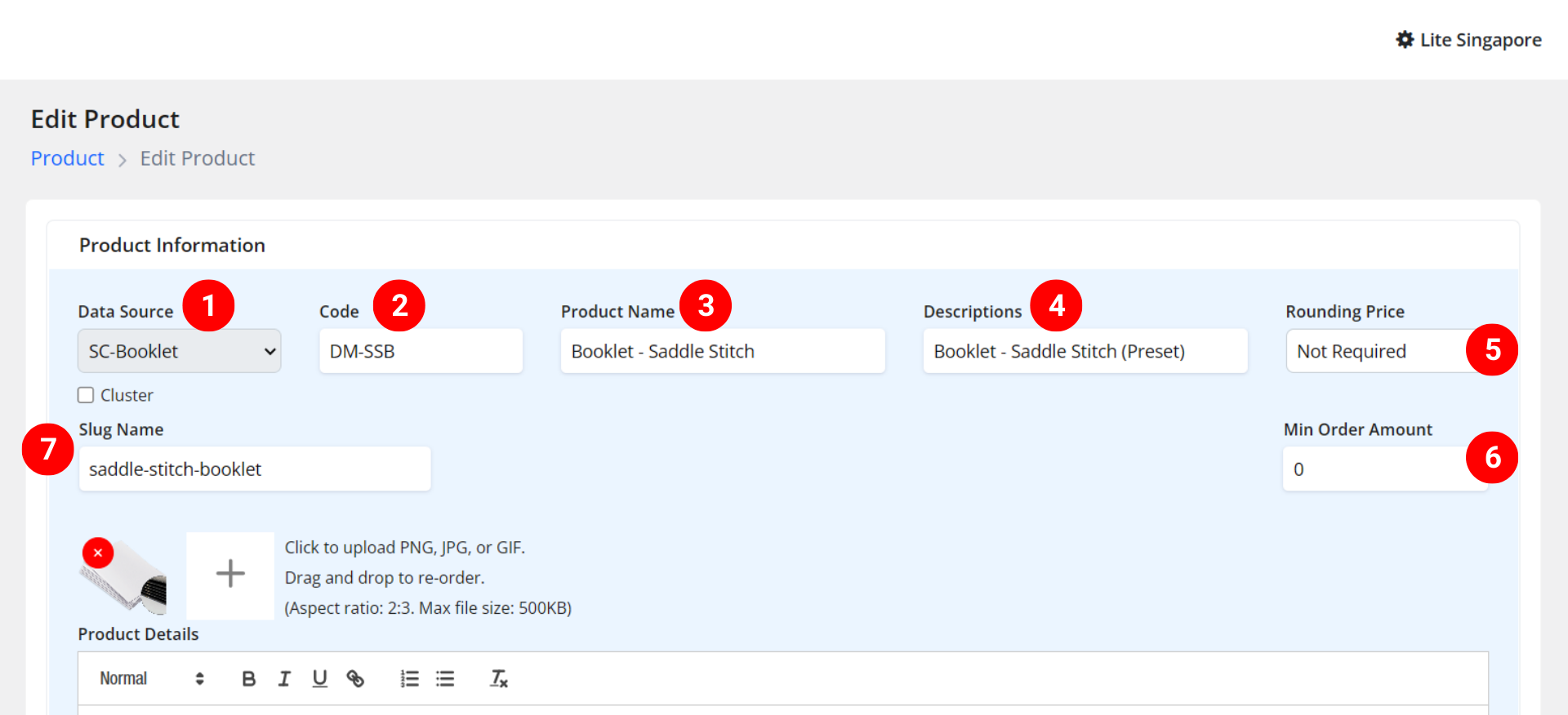
8. Upload your booklet product image
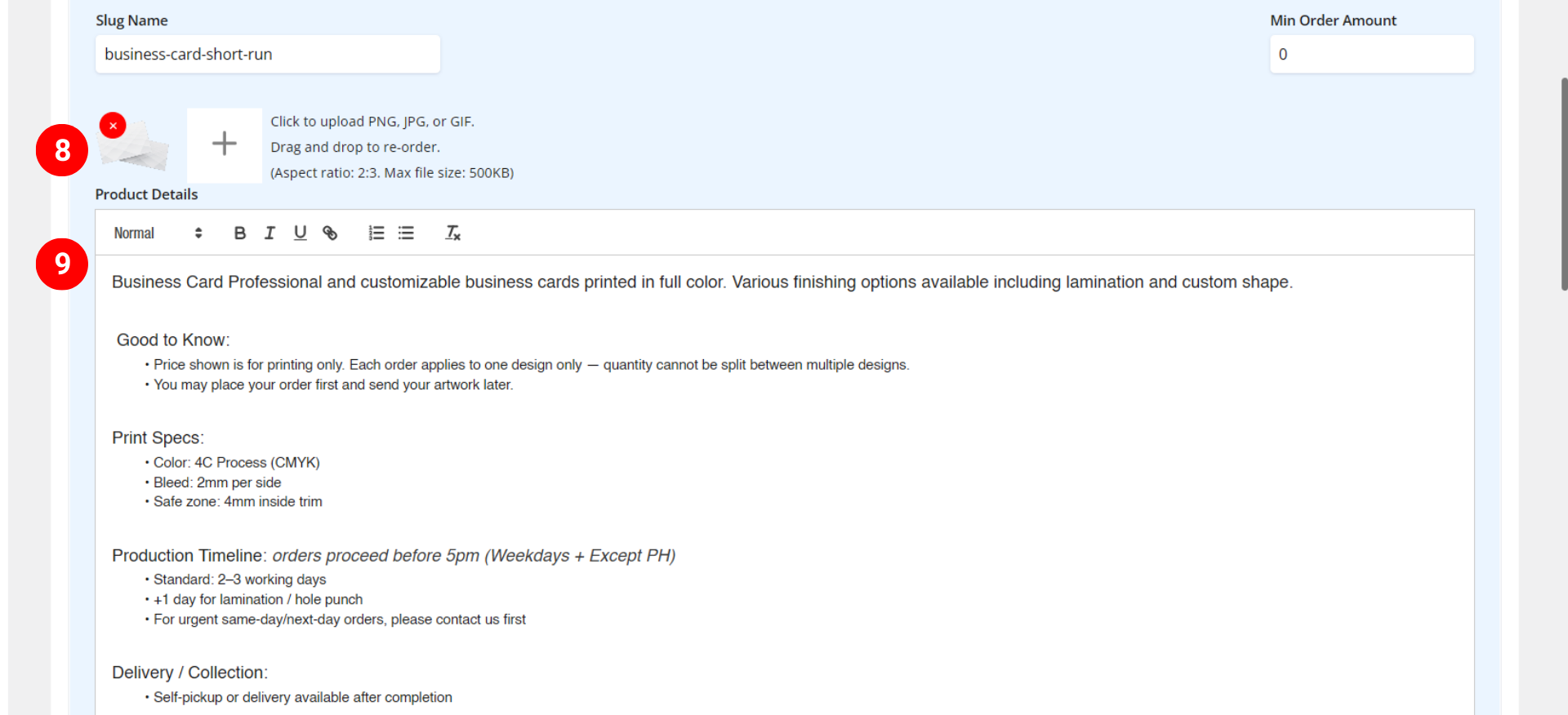
9. Fill in your product description, important information that needs to be communicated to customers, such as “Good to know”, printing specs, production timeline, etc
🔗 Related tutorial: SC-Booklet Product Creation
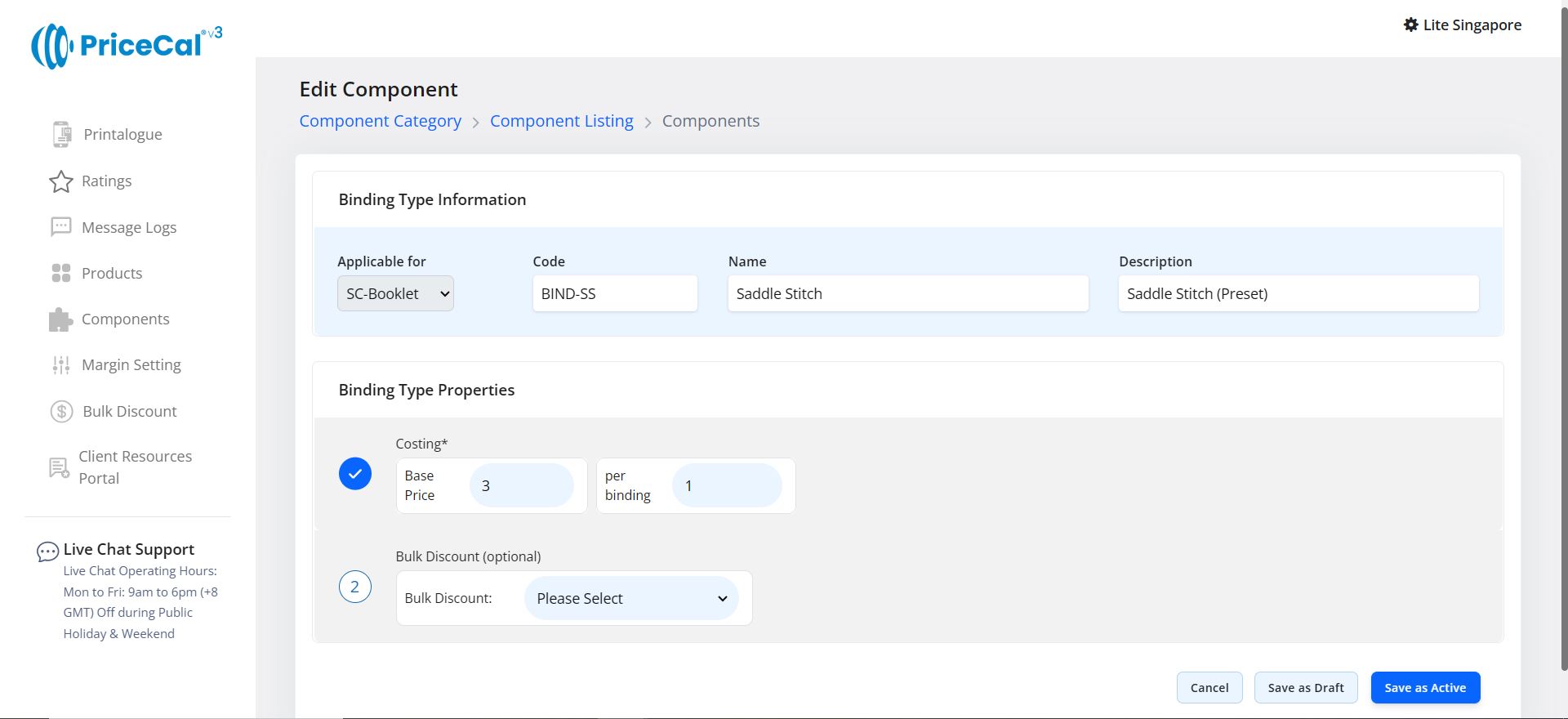
B. Add Binding
- Example: Saddle Stitch Bind
i. Edit current component
ii. Add new component directly without going to the Component page.
iii. Hovering the mouse over a component will display its description, making it easy to understand what this component is before selecting it.
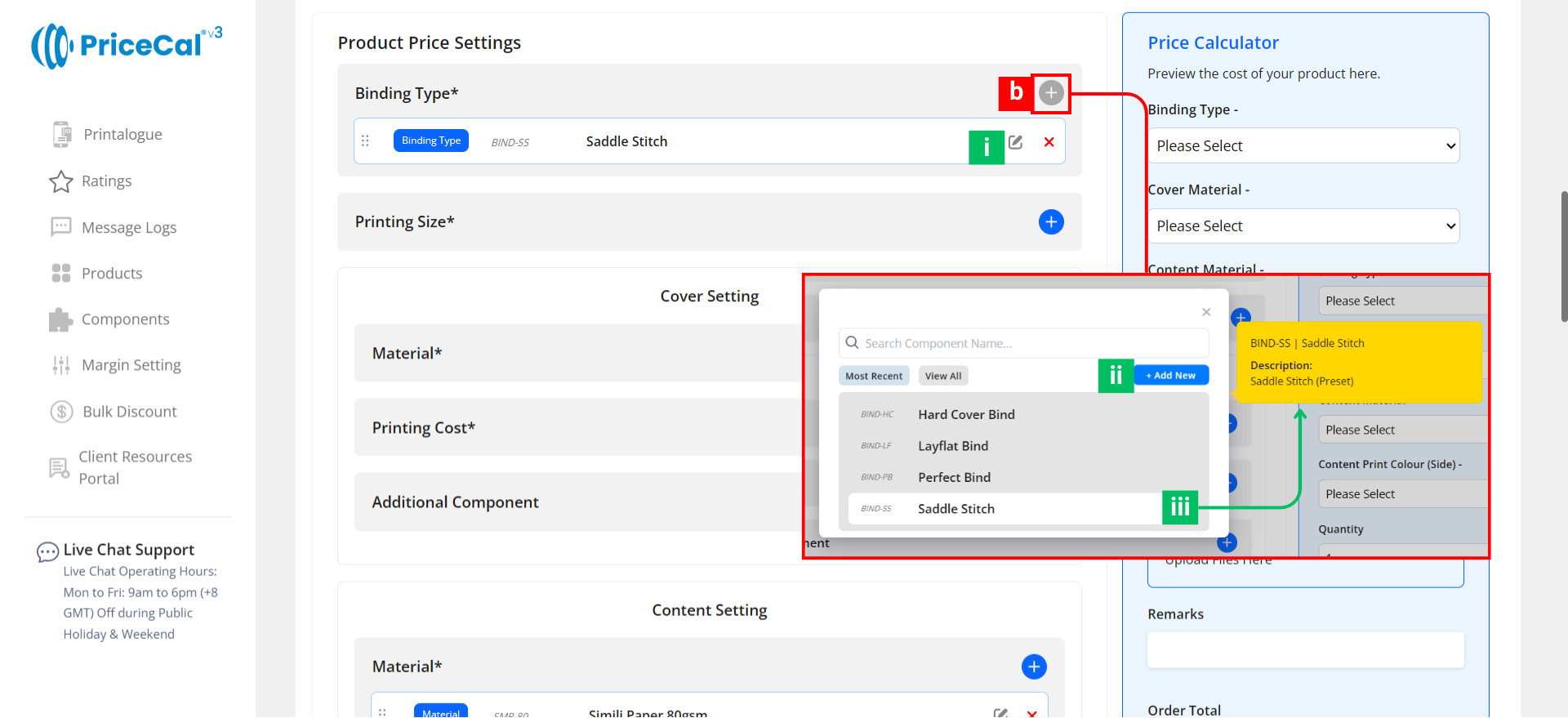
This image shows how a binding component is typically set up, so you can understand what each field means before creating your own.
🔗 Related tutorial: Binding Component Setup (Full Guide)
C. Define Printing Size
- Size label: Booklet Size
- Nesting type: Multi-Row Extension
- Enable bleed in the printing size component
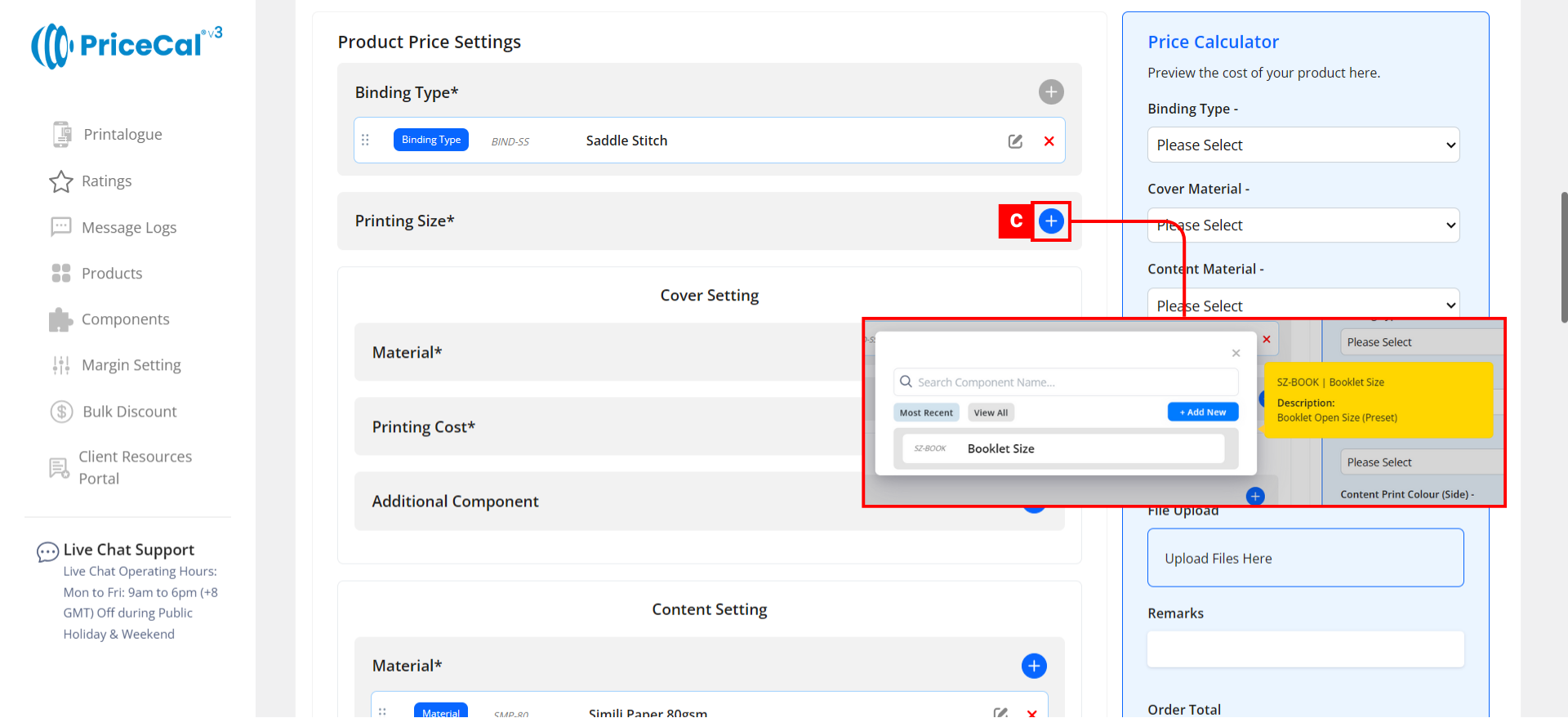
This image shows how a booklet printing size component is typically set up, so you can understand what each field means before creating your own.
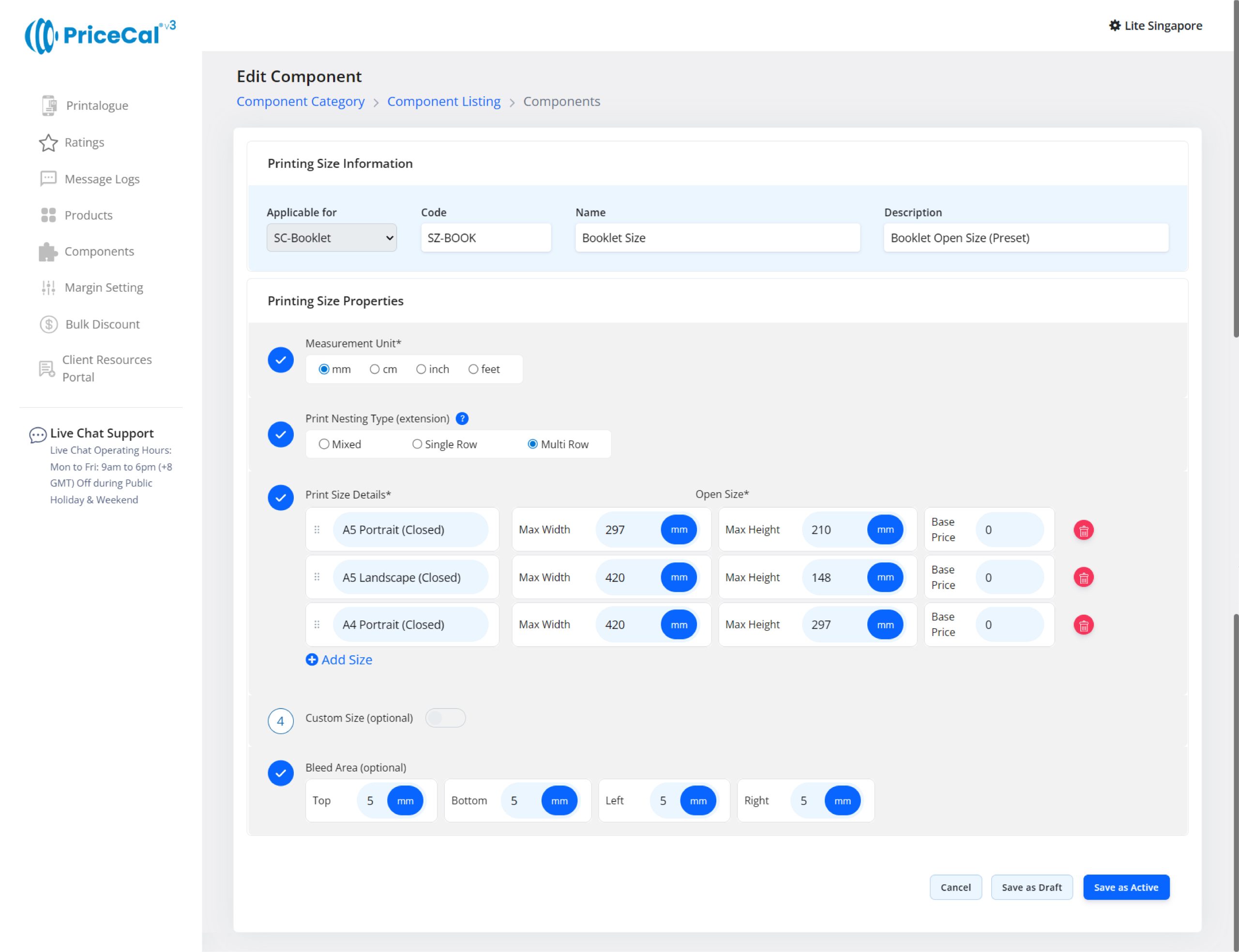
🔗 Related tutorial: SC-Booklet Printing Size Setup (Full Guide)
D. Set Material for COVER booklet
- Example: 250gsm Art Card
- Add more paper options if needed
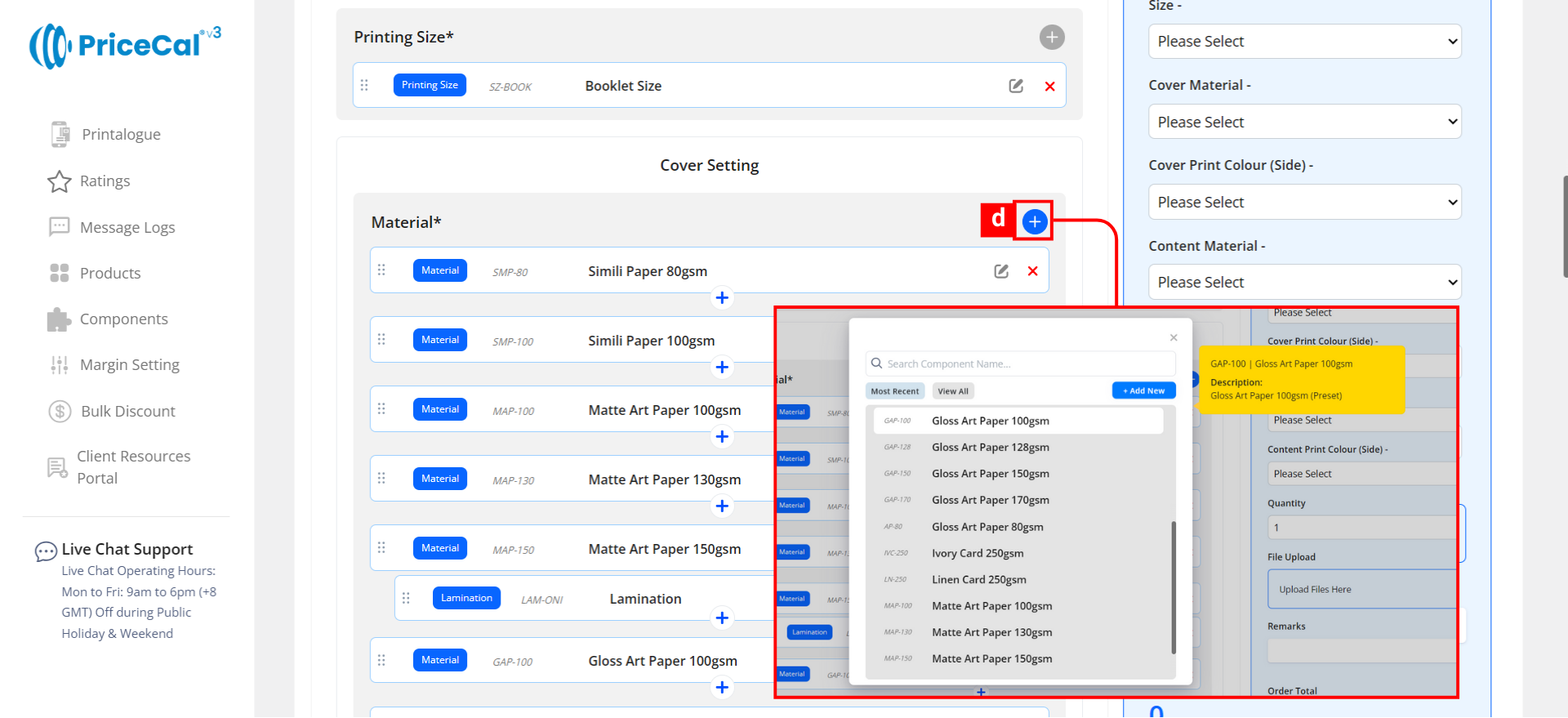
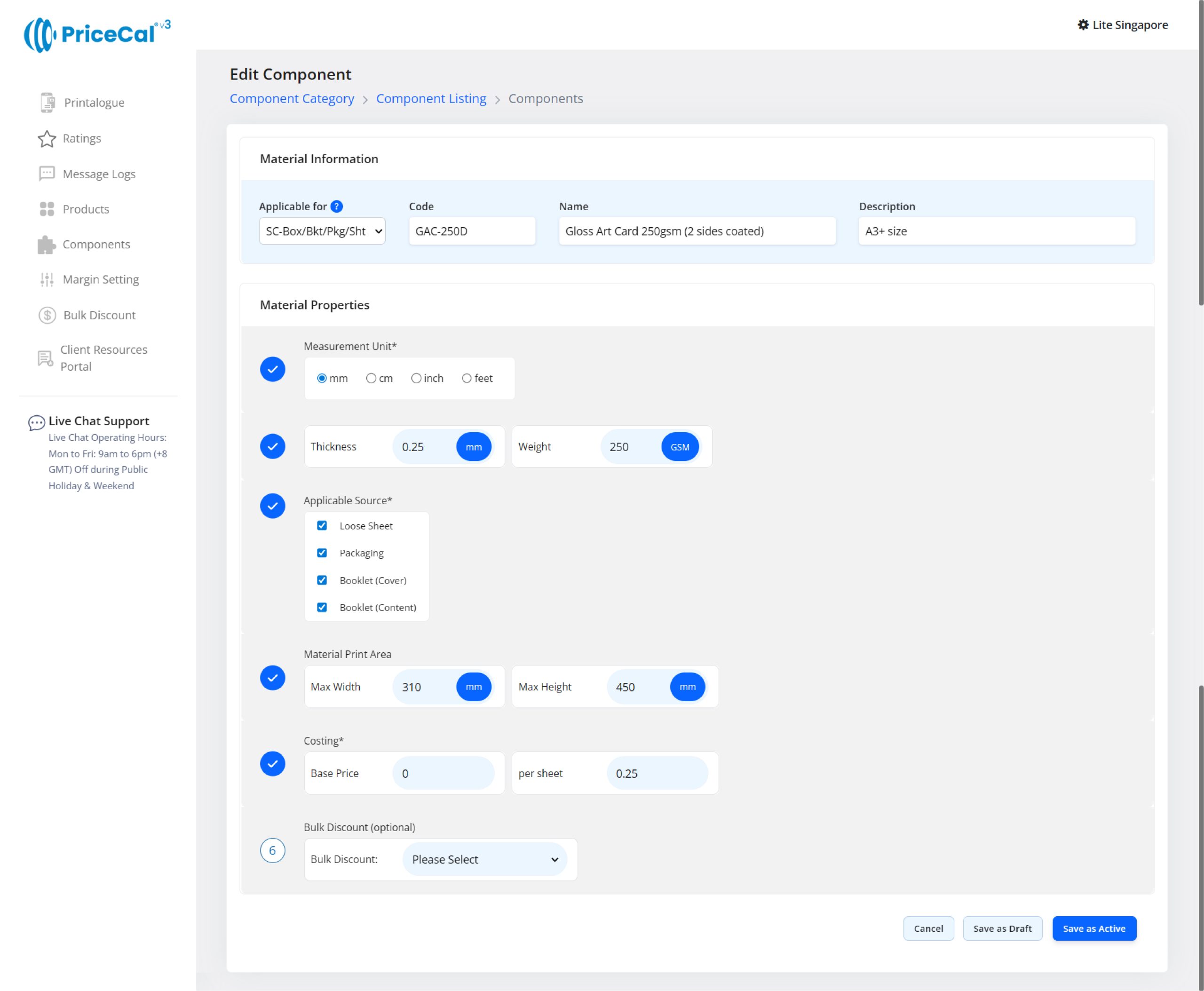
This image shows how a sheet-form Material component is typically set up, so you can understand what each field means before creating your own.
- In “Applicable Sources”, tick the product types for which this material can be printed.
– Book Cover: for booklet Cover pages only (SC-Booklet)
– Book Content: for booklet Content pages only (SC-Booklet)
– If this material is suitable for the corresponding product category, you can also check “Loose Sheet” (SC-Sheet, sheet form printing: flyer, business card, sticker…) and “Packaging” (SC-Packaging / Box).
🔗 Related tutorial: Material Component Setup (Full Guide)
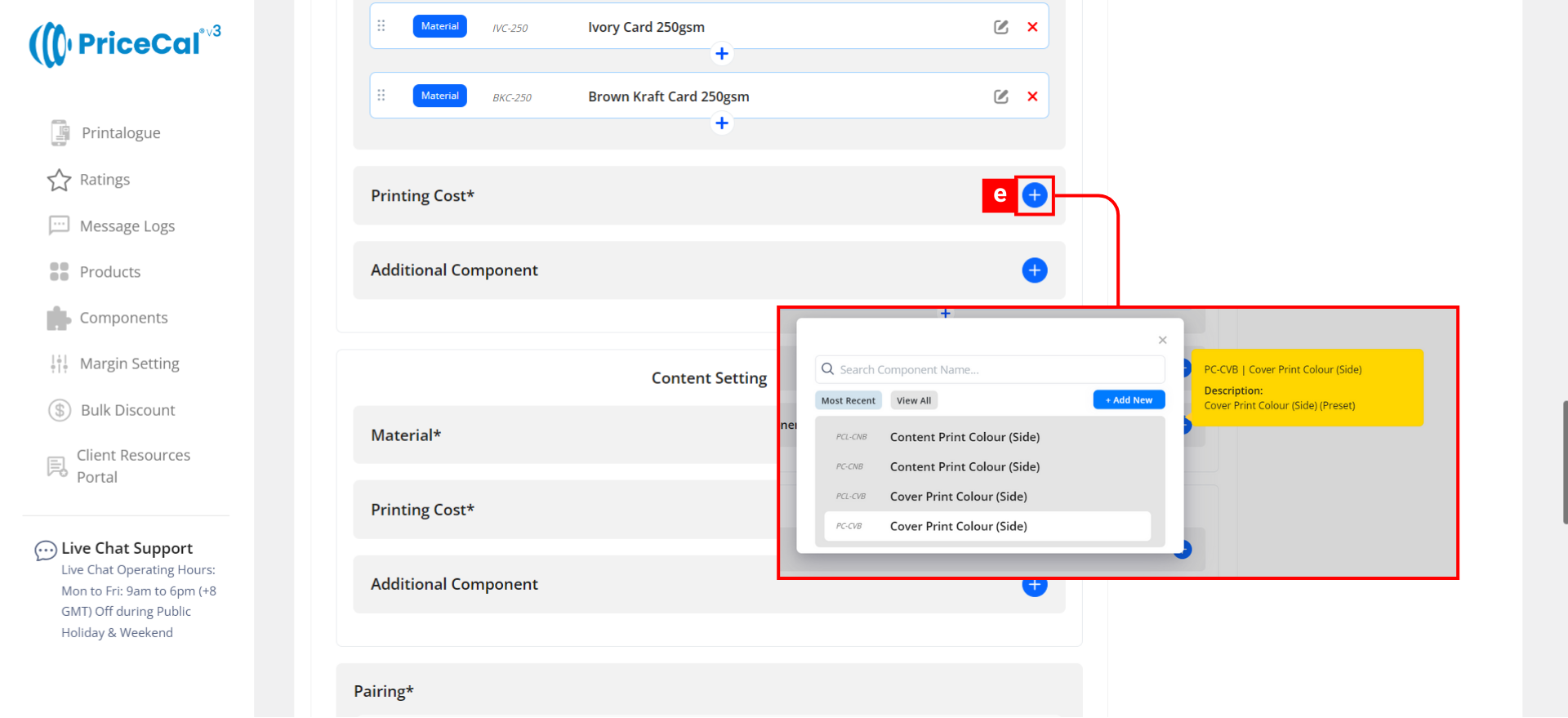
E. Set COVER page Printing Cost
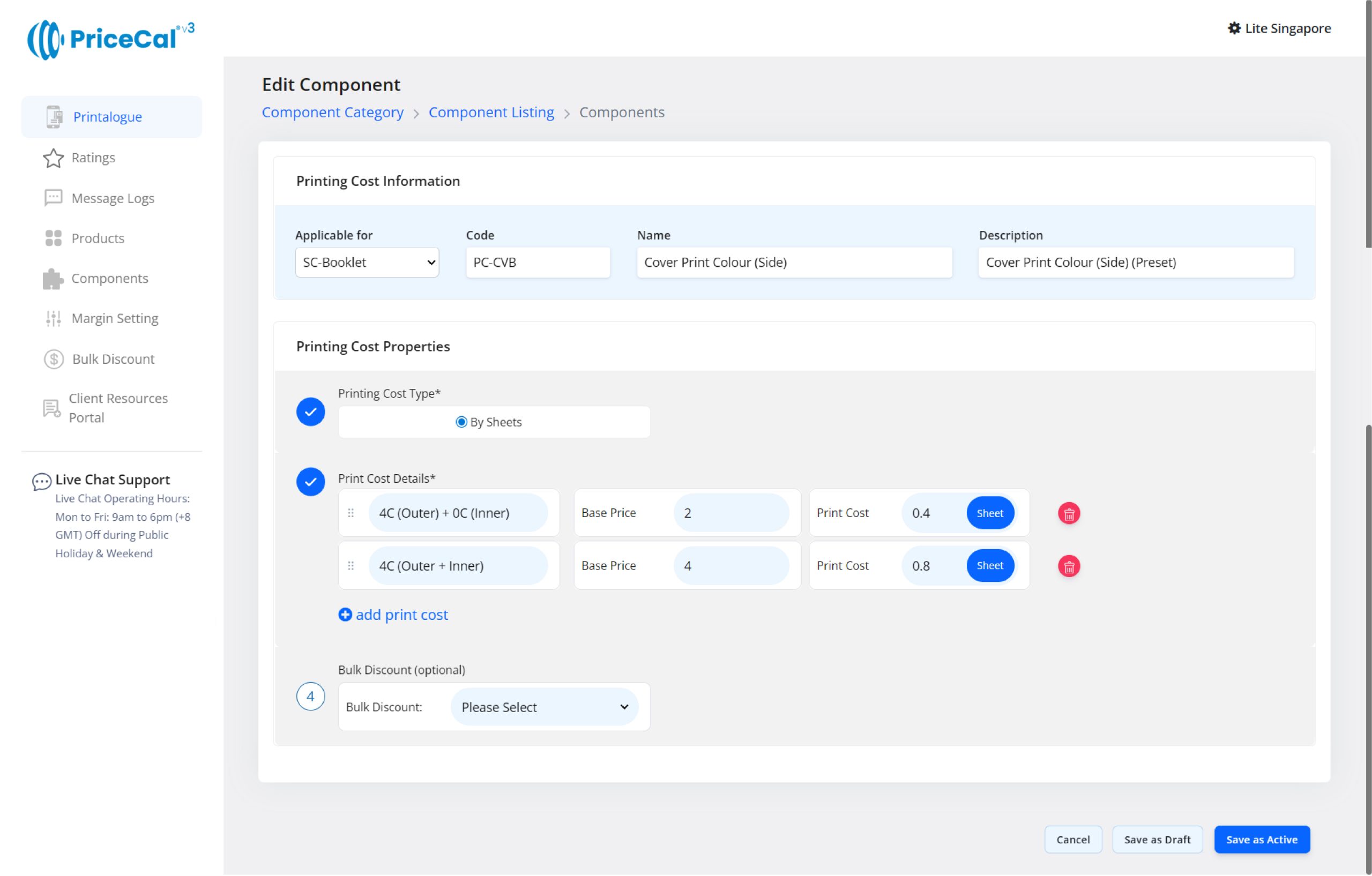
- Select printing colour for Cover page (Outer or Outer+Inner)
- Define cost per sheet X per side
This image shows how a Cover printing cost (printing colour/side) component is typically set up for booklet product, so you can understand what each field means before creating your own.
🔗 Related tutorial: Printing Cost Setup (Full Guide)
F. Optional Add-ons for COVER Booklet
-
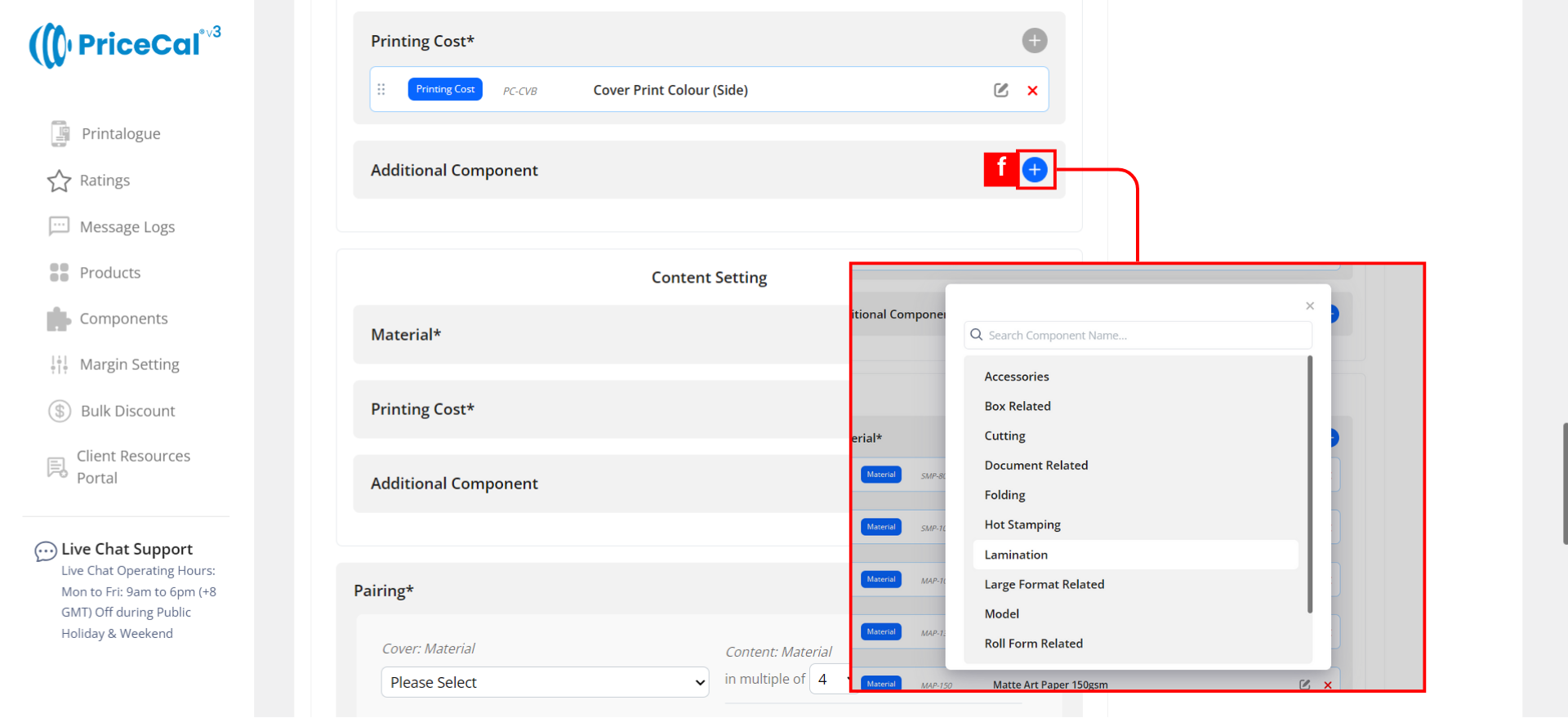
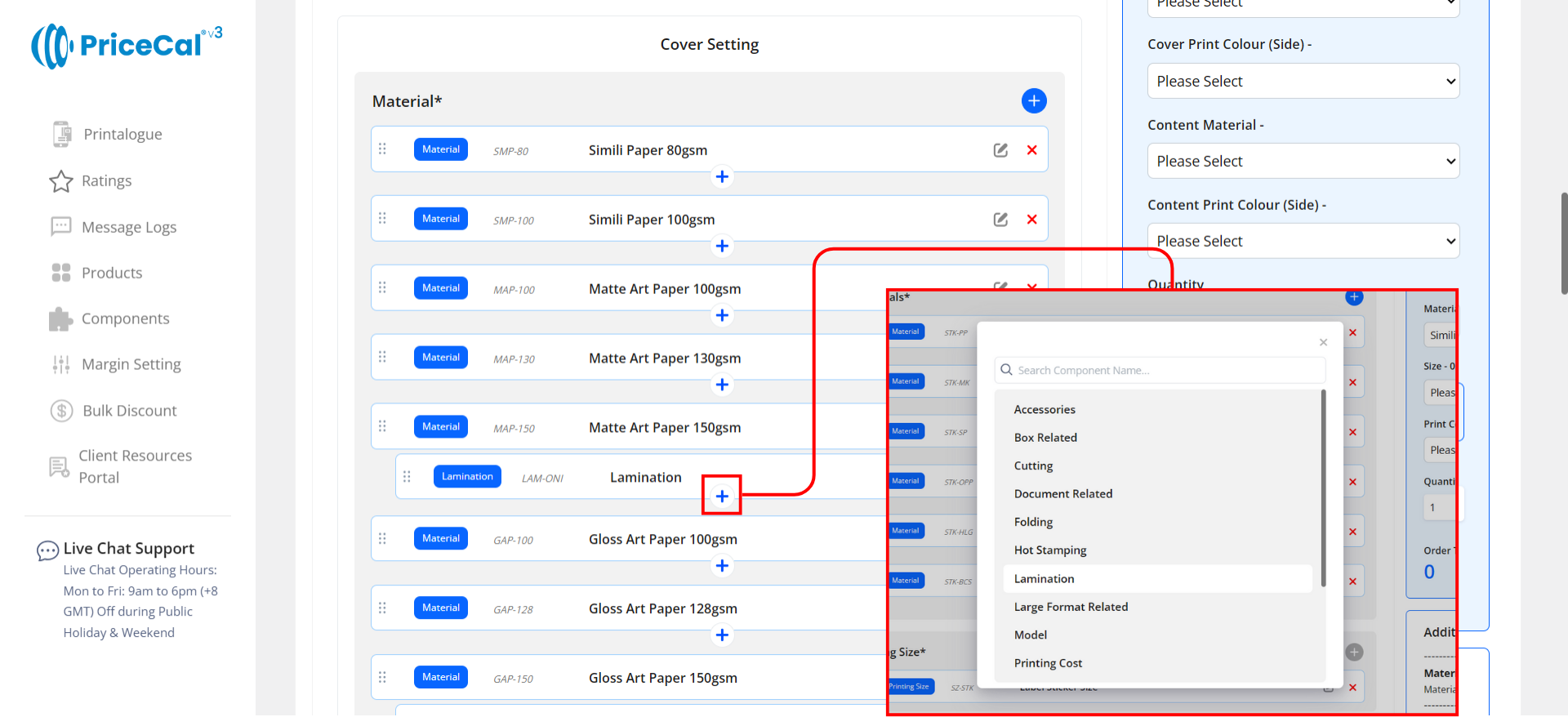
Custom Component: choose the finishing component category like Lamination, VDP. And add the component.
Tips 💡: You can add unique components to a material. For example, if custom component lamination cannot be used on all materials, then we need to attach the lamination component under the applicable materials.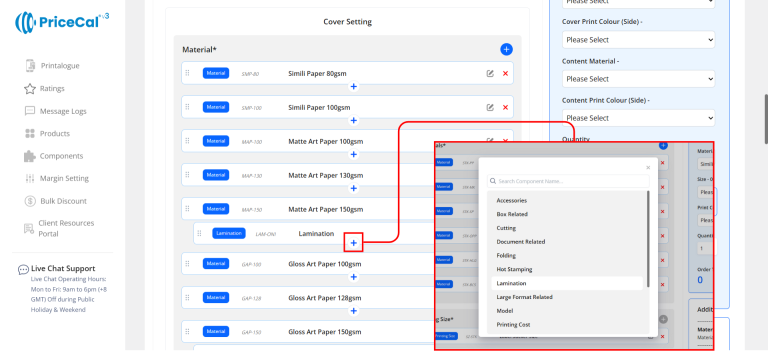
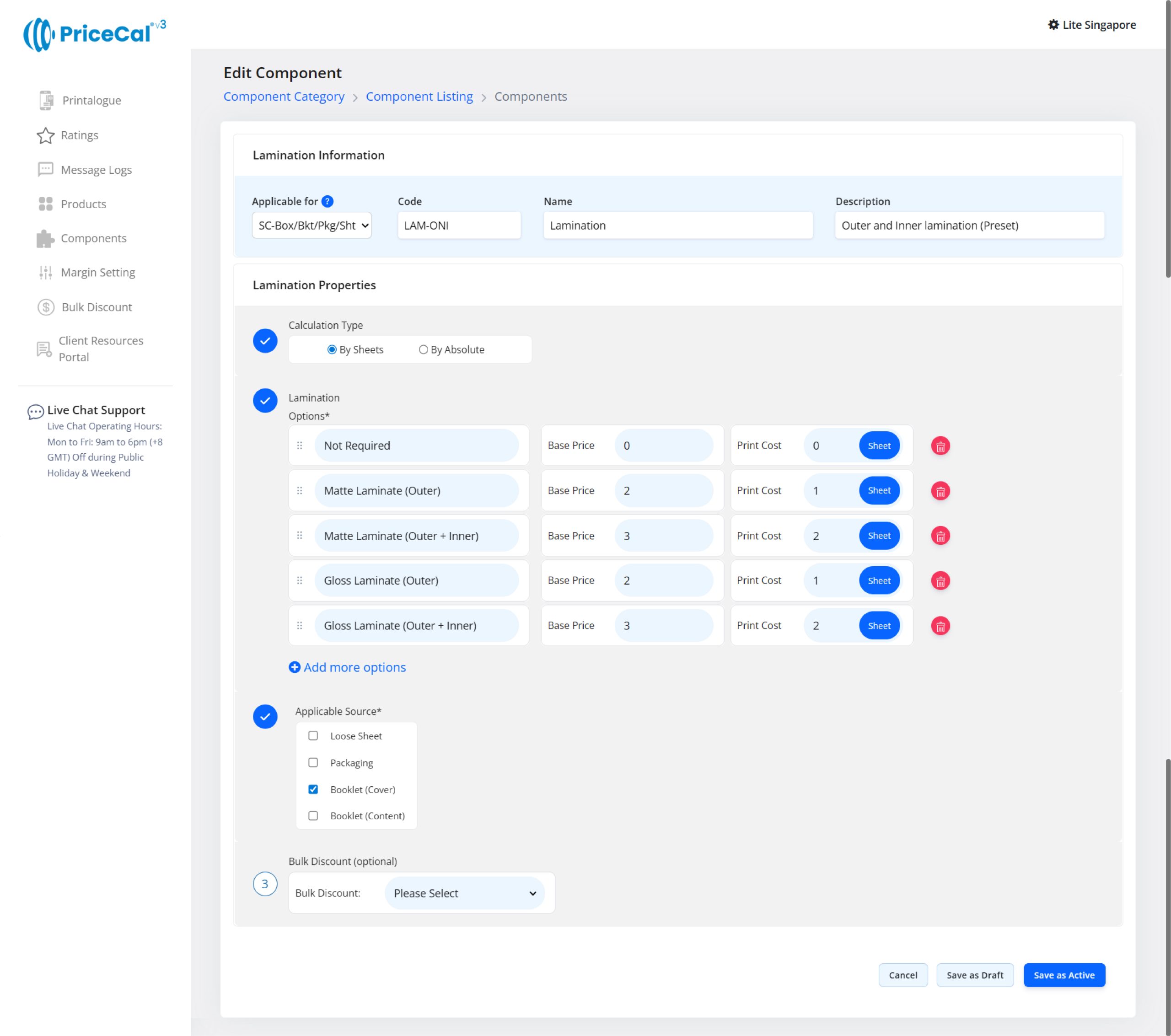
This image shows how a custom component is typically set up, so you can understand what each field means before creating your own.
– Lamination (by sheet)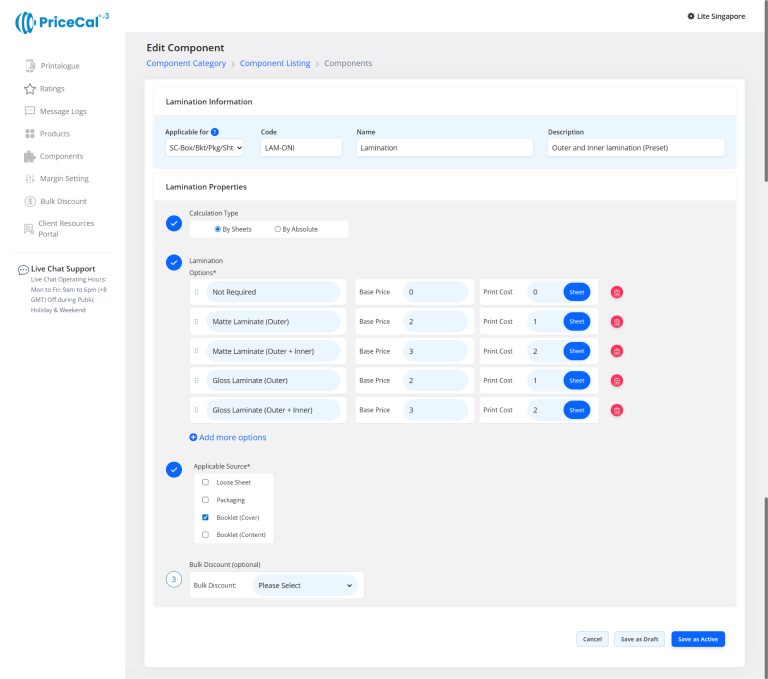
G. Set Material for CONTENT booklet
- Add paper materials suitable for the content pages printing.
- Add more paper options if needed
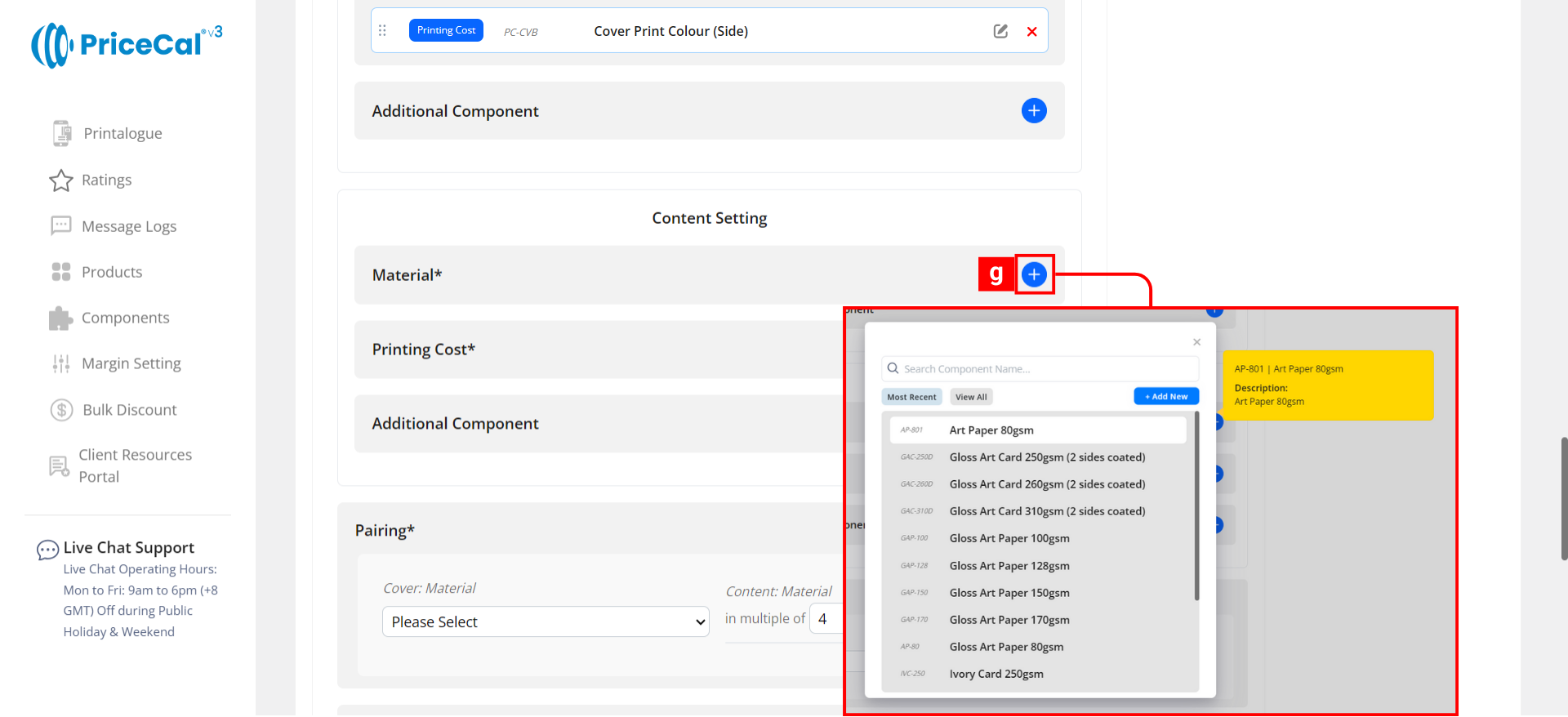
This image shows how a sheet-form Material component is typically set up, so you can understand what each field means before creating your own.
🔗 Related tutorial: Material Component Setup (Full Guide)
H. Set CONTENT pages Printing Cost
- Select printing colour for content page (Grayscale or Colour)
- Define cost per sheet X print colour
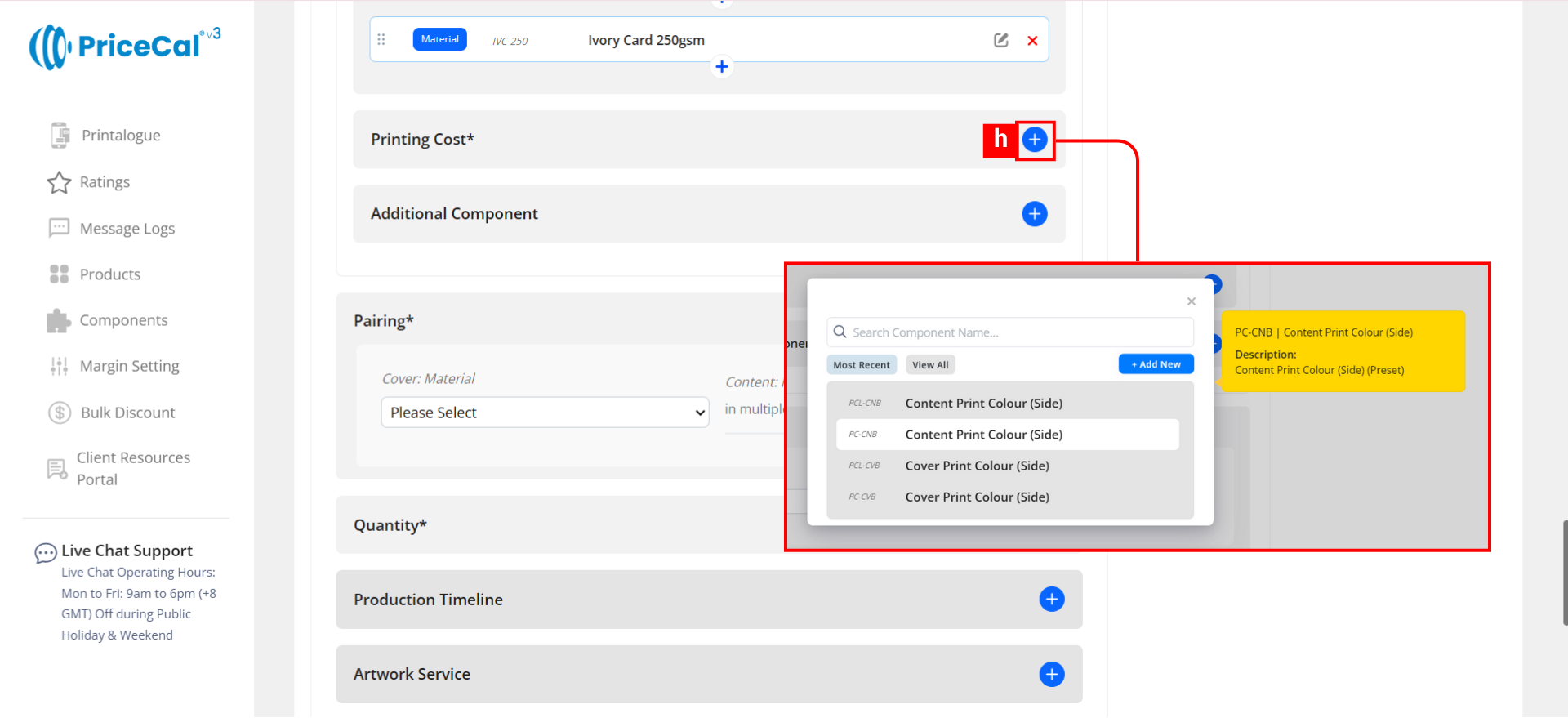
This image shows how a Content pages printing cost (printing colour/side) component is typically set up for booklet products, so you can understand what each field means before creating your own.
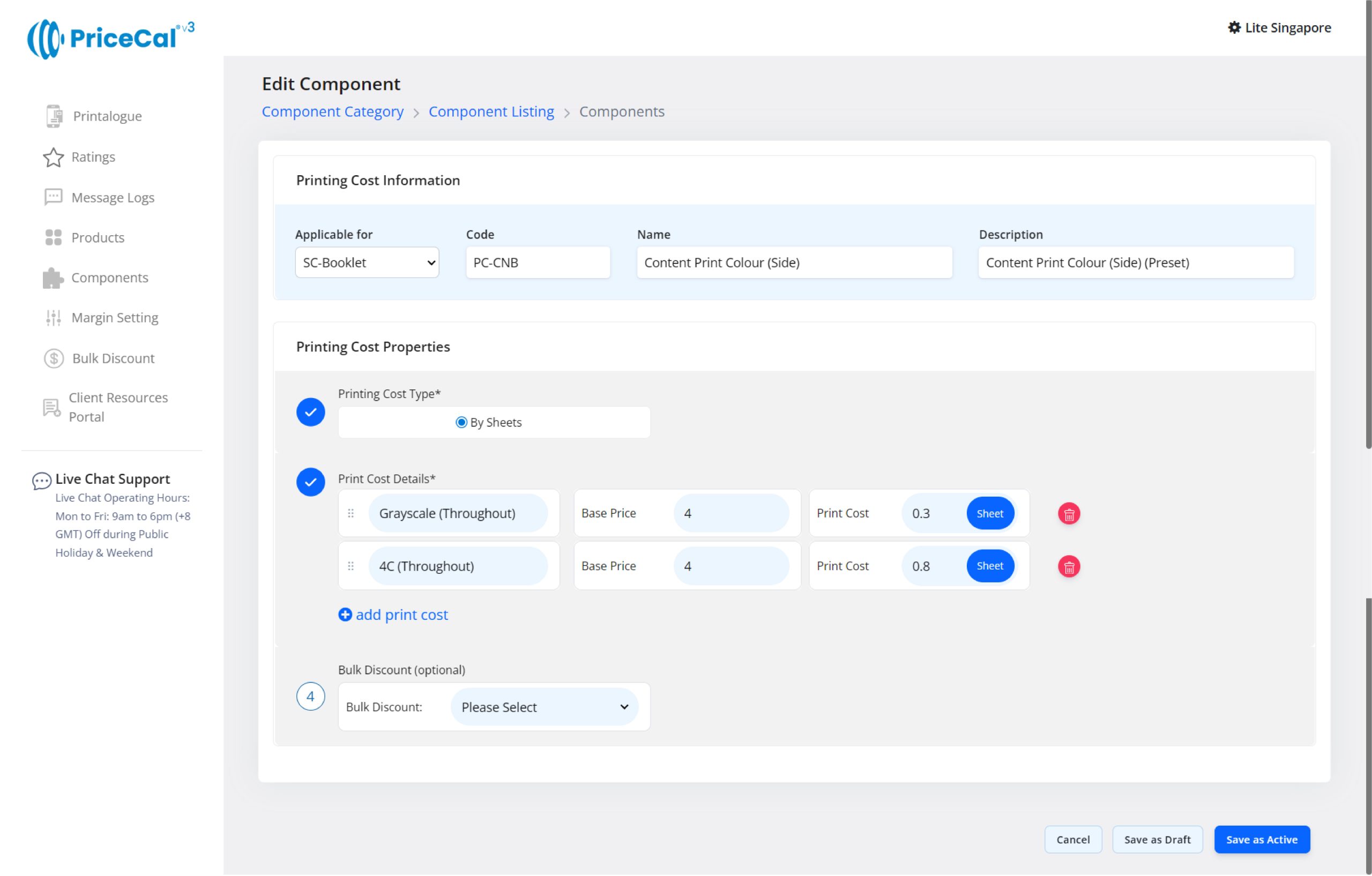
🔗 Related tutorial: Printing Cost Setup (Full Guide)
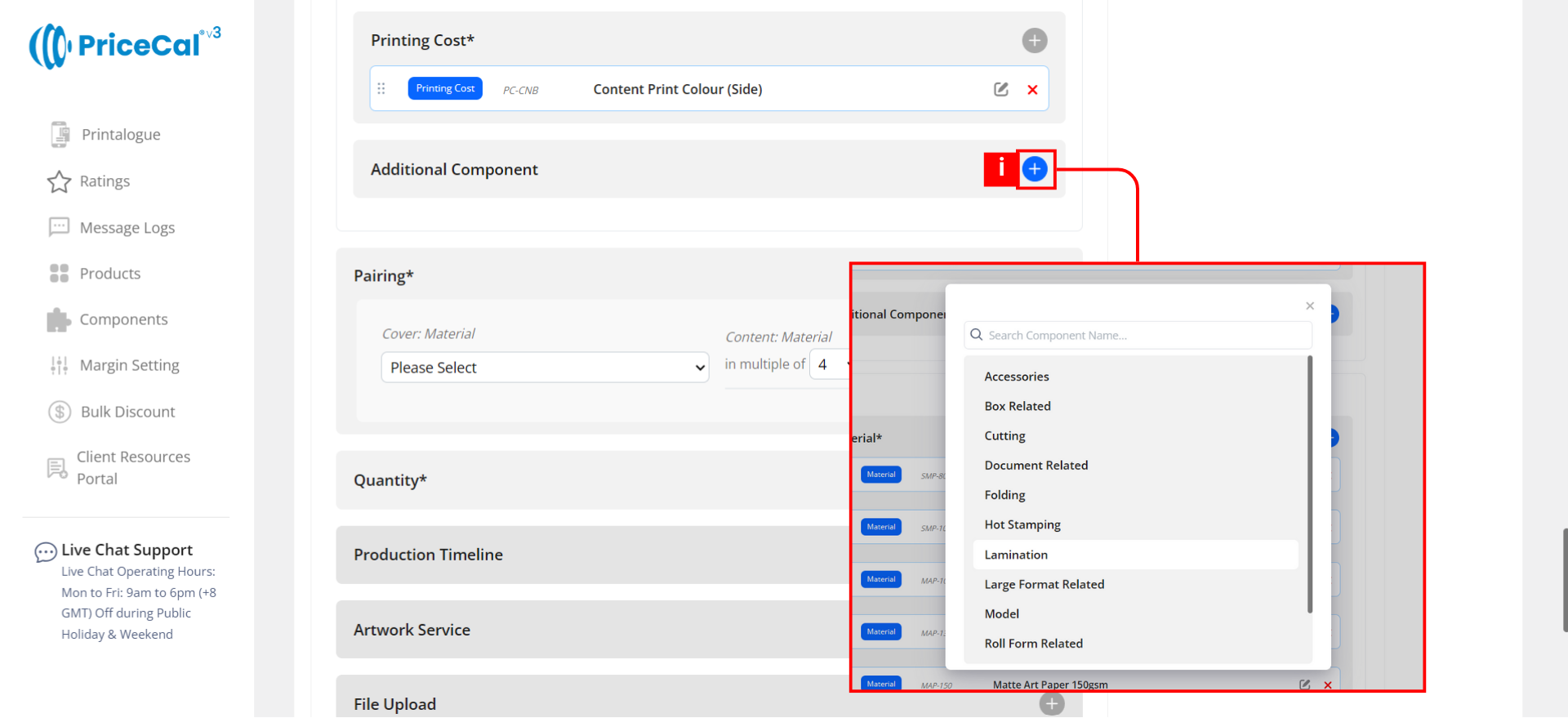
I. Optional Add-ons for CONTENT Booklet
-
Custom Component: choose the finishing component category like Lamination. And add the component.
**If finishing is not required for printing content, then we don’t need to include it in the component.
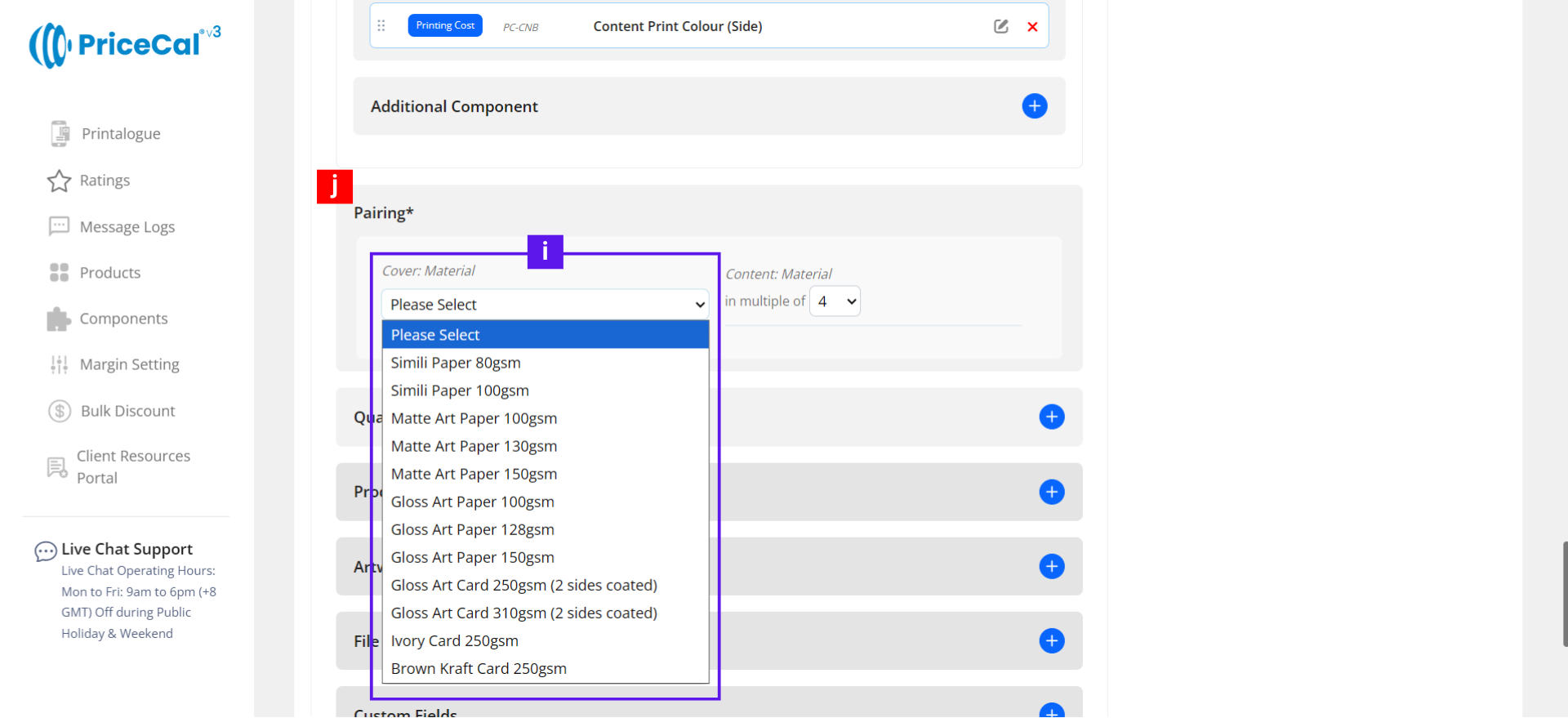
J. Set Up Material Pairing
[i] Need to choose the cover material.
[ii] Choose in multiple of “4” for saddle stitch booklet.
[iii] Select the content that matches the cover material you choose to avoid having the content material thicker than the cover material.
Example: Cover material is Matt Art Paper 150gsm > The Content page material can only be similar paper/matte art paper, and the GSM is less than 150gsm.
Therefore, customers can only choose the content material according to the cover material.
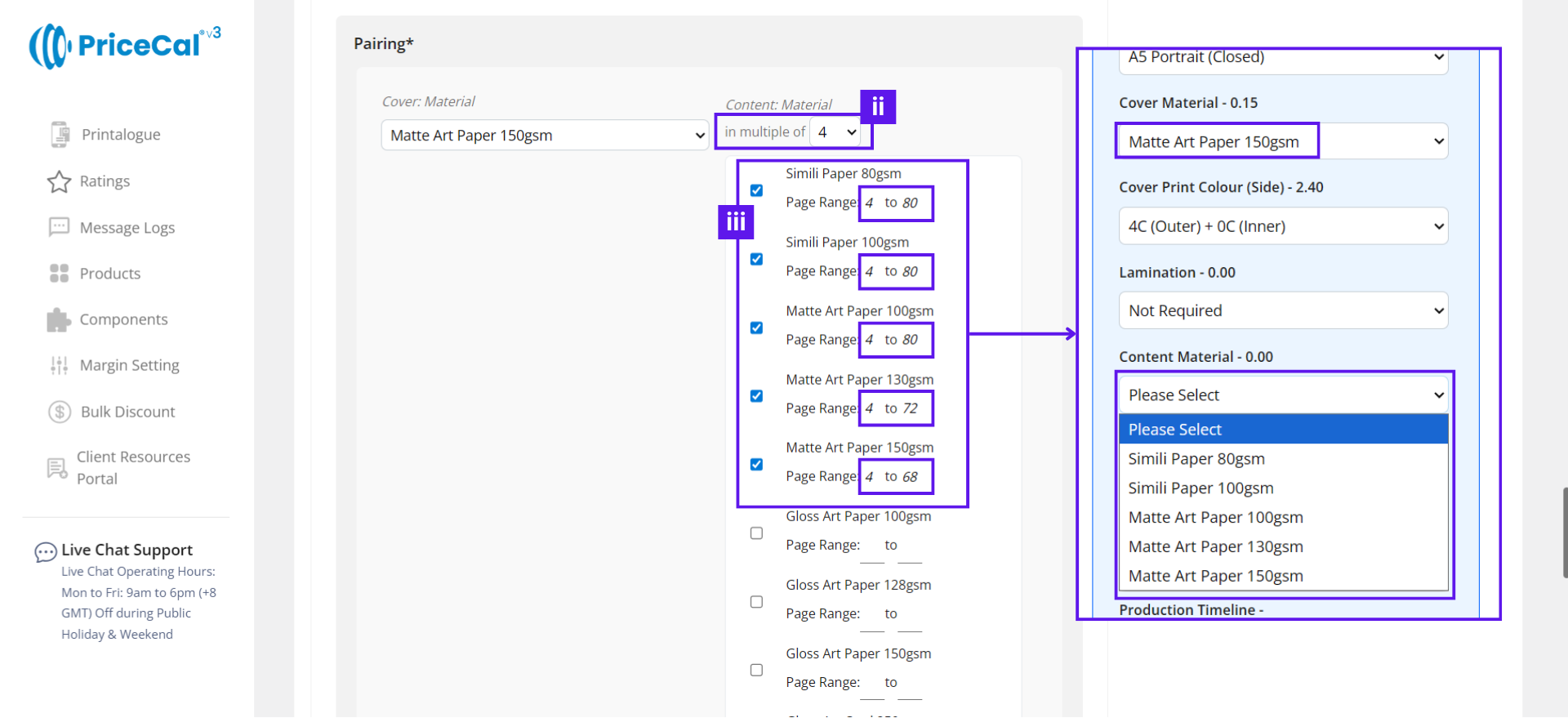
**You need to select the corresponding Content material for each Cover material.
K. Quantity Selection
- We need to use “Custom + Increment” to set a preset quantity, Example quantities: 50 / 100 / 200 / 300 / 400 / 500…
- System will auto-preset the quantity of prints that the customer can choose.
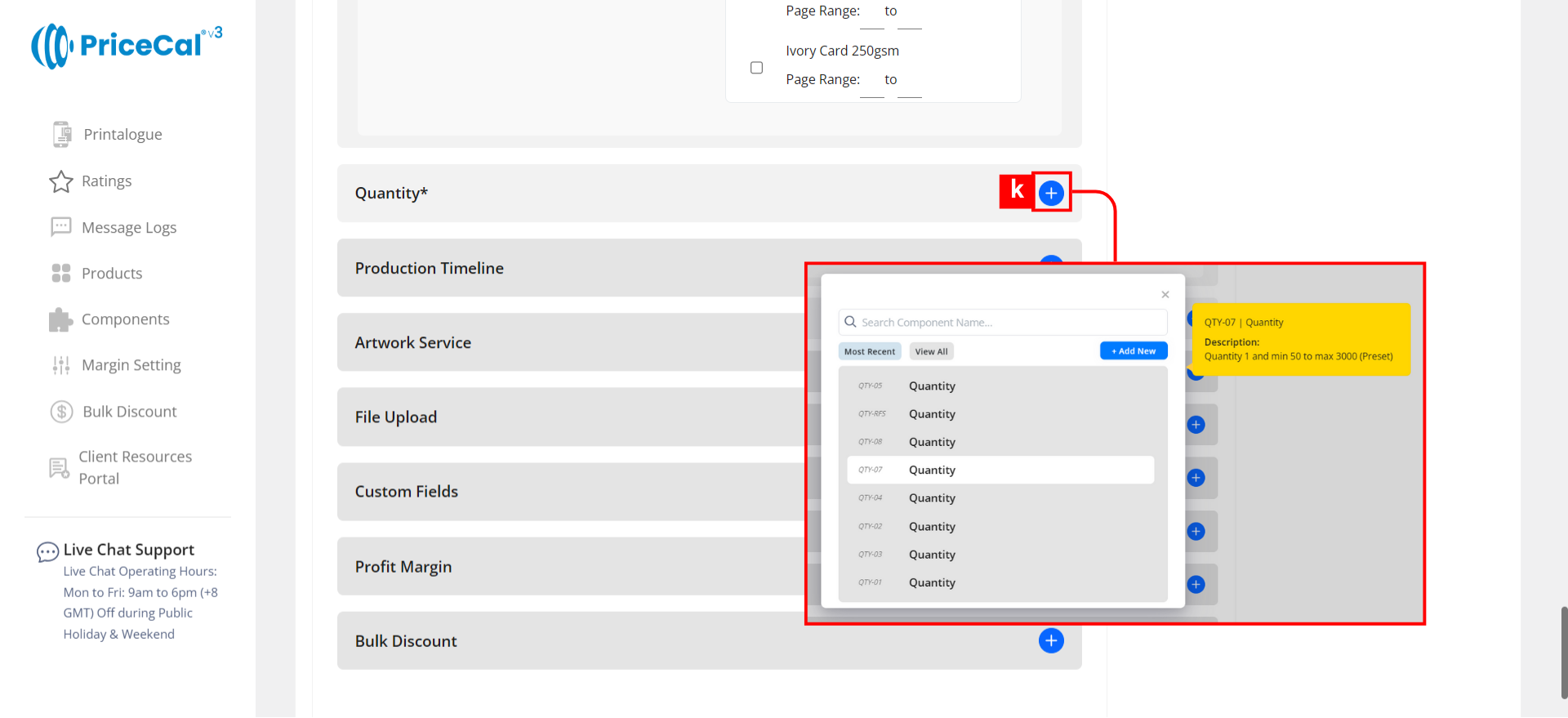
This image shows how a quantity component is typically set up, so you can understand what each field means before creating your own.
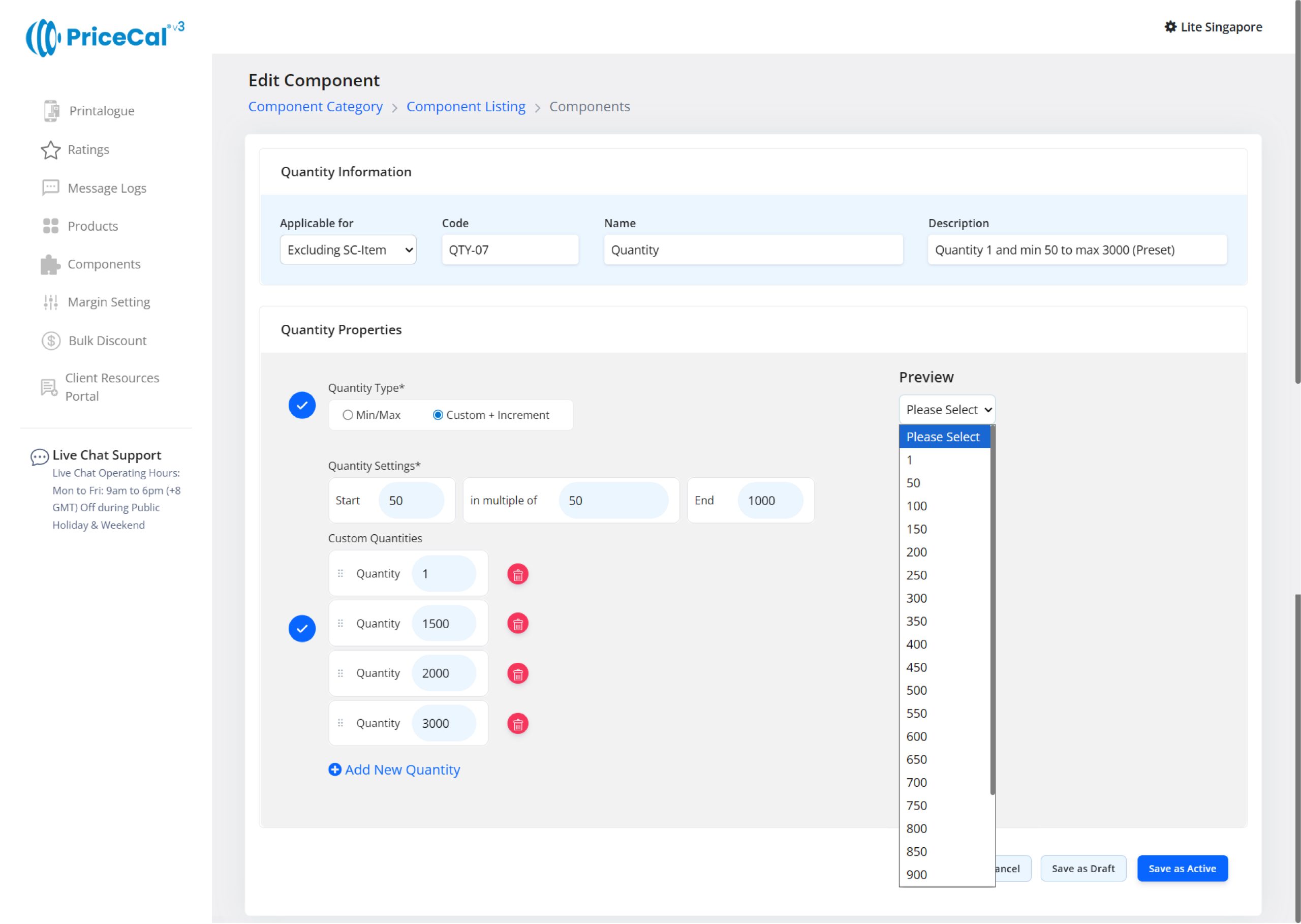
🔗 Related tutorial: Quantity Component (Full Guide)
L. Optional Add-ons
-
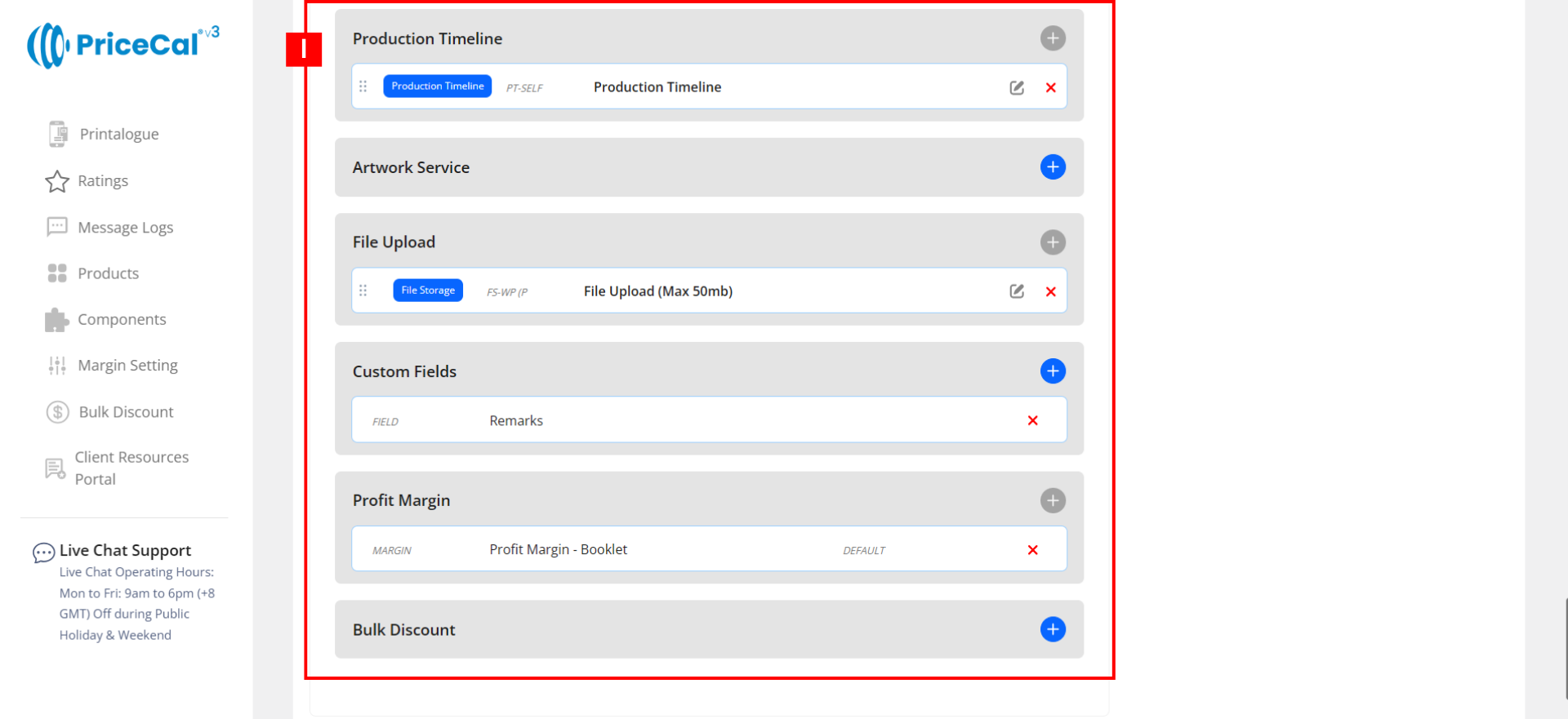
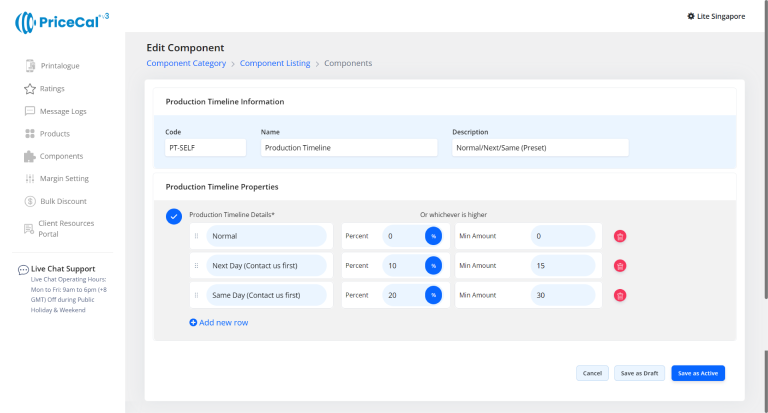
Production timeline: As this is in-house production, you can control production time to provide flexible production speeds (Normal/Next Day/Same Day).
-
Artwork Service: If you offer booklet artwork services, please set the artwork service option.
-
File Upload: Enable file upload and select storage location (WordPress or Dropbox). [Only displayed after integration into WordPress website]
-
Custom Fields: Collect extra info or artwork links (e.g., Google Drive link, ).[Only displayed after integration into WordPress website]
-
Profit Margin: Apply different profit percentage levels for booklet product category.
-
Bulk Discount: If you want to automatically apply discounts to bulk orders, apply a Bulk Discount to the product.
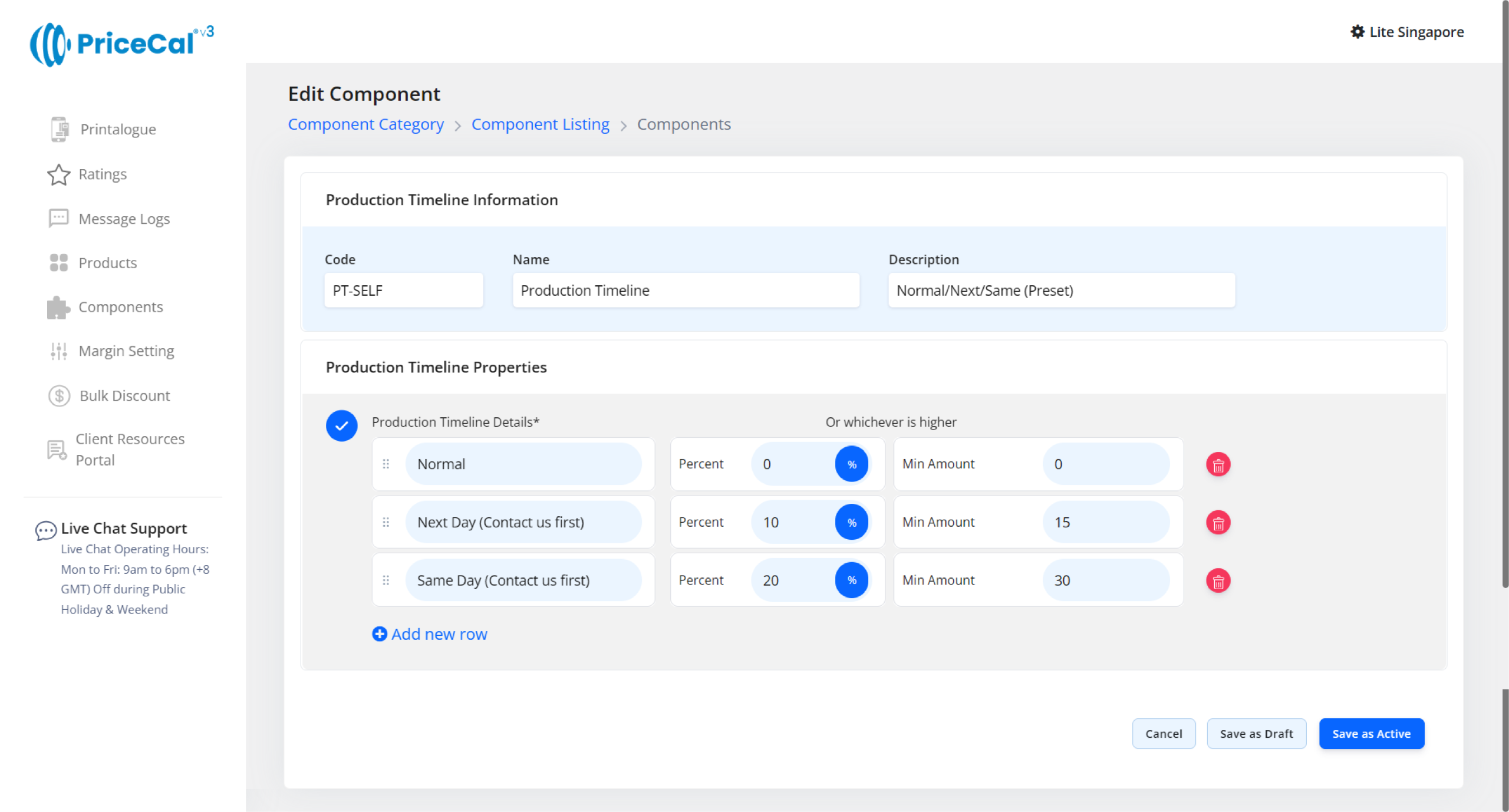
Preview & Publish
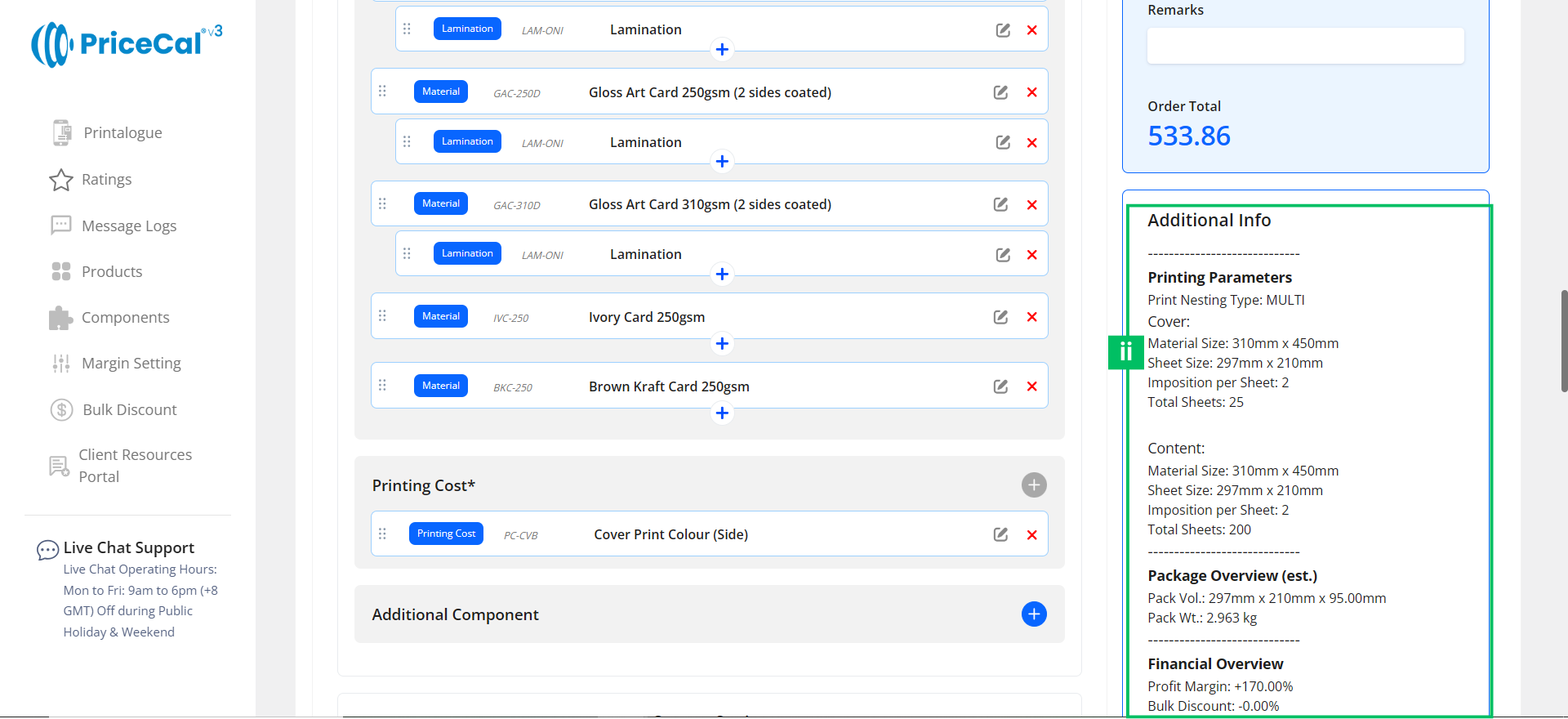
i. Check cost breakdown: You can view the corresponding costs based on the selected print size and quantity.
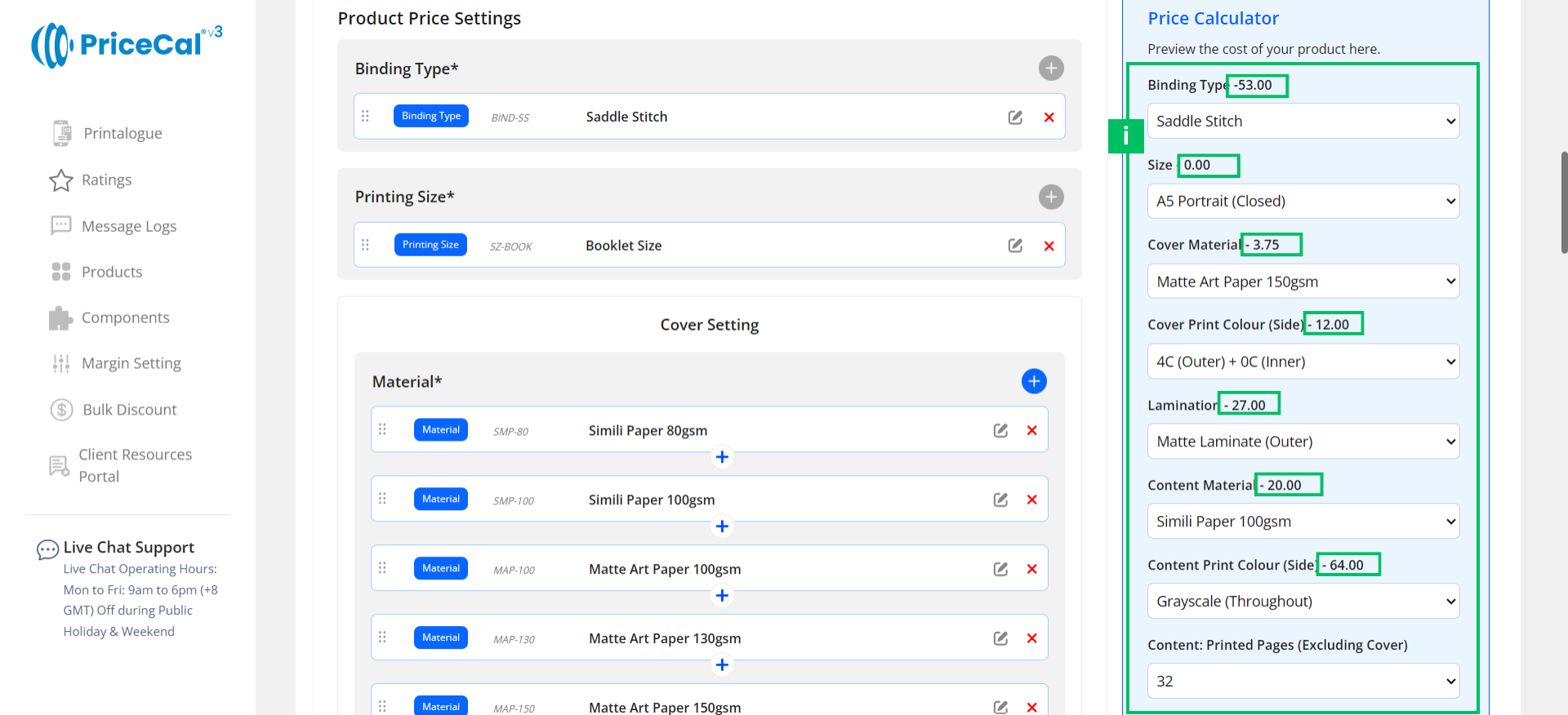
ii. Check the additional inform: Get instant calculation insights
-
- Material Summary – Shows the maximum print area of the material selected in the Price Calculator.
- Printing Parameters – Displays the nesting type, sheet size, imposition per sheet, and total sheets required.
Example (A5 Closed size booklet, 50 books):- The selected open booklet size (print size) is 297mm x 210mm.
- For production, the system adds 5mm bleed on each side, so the working size becomes 307mm x 220mm.
- This 307mm x 220mm size is imposed into the maximum print area 310mm × 450mm.
- Final imposition is 2 pcs per material sheet.
- To produce 50 books, total cover material sheets needed = 1 cover sheet x 50 books /2up = sheets, and total content material sheets needed = (32 pages/4) content sheet x 50 books / 2up = 200 sheets.
- Package Overview (est.) – Estimates volume and weight based on GSM, material thickness, and quantity.
- Financial Overview – Summarizes the applied profit margin and any bulk discount applied.
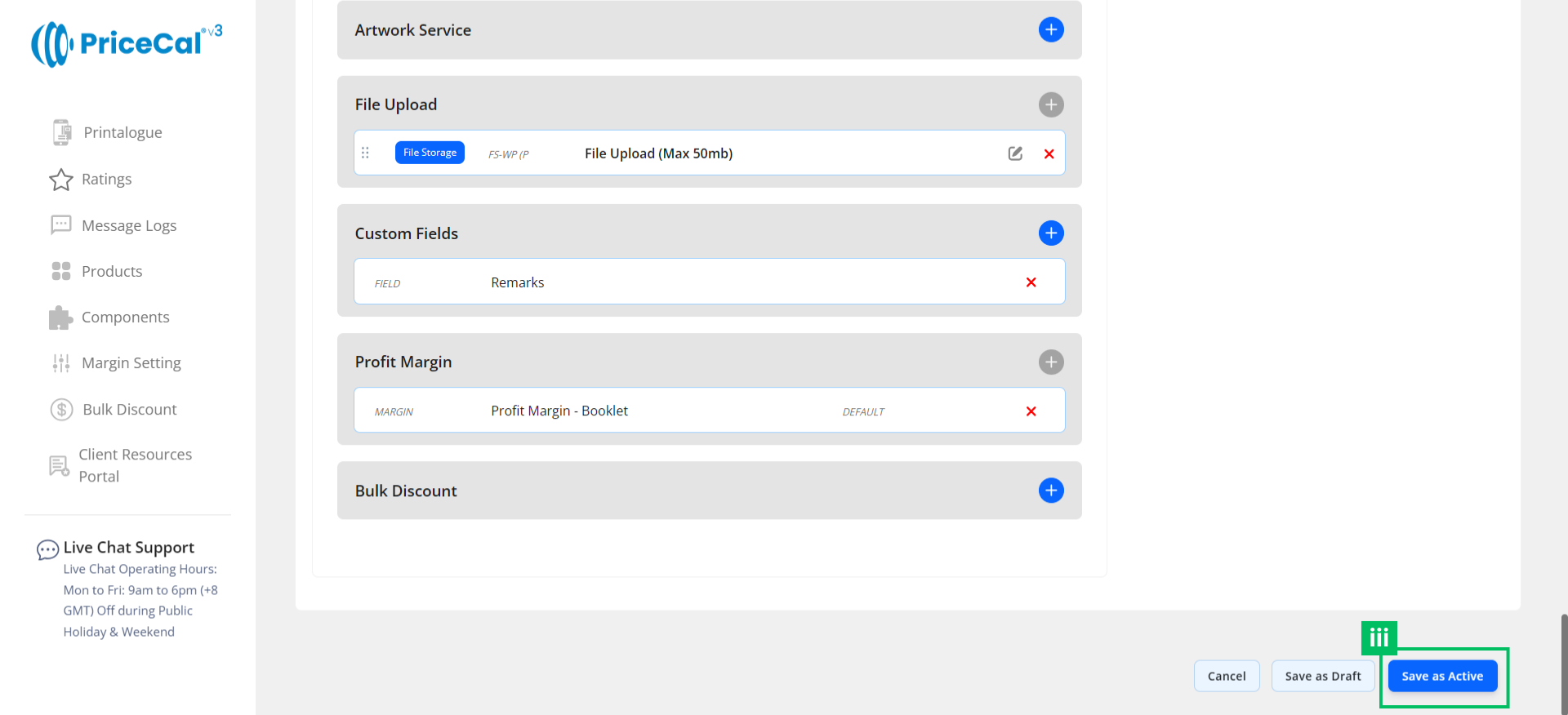
iii. Click Save as Active
✅ Result: Production-accurate, page-aware pricing for saddle stitch booklets.
Final Outcome (Customer Experience)
Customers can:
- Choose booklet size
- Select cover & content paper
- Enter page count
- Select quantity
- Instantly see accurate price
- Place order confidently